A Card Game of the World's Folklore
Every culture on earth told the same story in its own voice: something dies, and the world turns, and it comes back changed. MORANA is a mythology card game built to visit those tellings one tradition at a time, on one shared engine, from public-domain sources only. This page is the whole map.
The First Turning, the set you can play in your browser today, is Slavic and Balkan folklore: the Domovoi behind the stove, the Rusalka in the reeds, Baba Yaga, Koschei the Deathless, the Firebird, and Morana herself, the winter goddess of death and return. It is a complete game in one box. And it is chapter one of a mapped saga, whose full shape and single cosmology you can read in The Ten Worlds of MORANA.
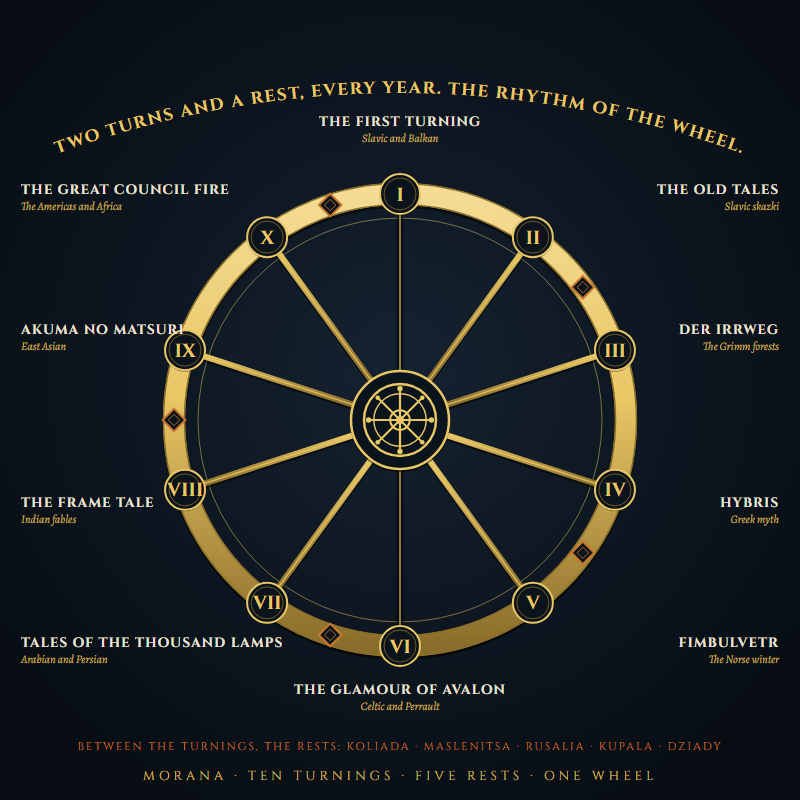
The Ten Turnings
The origin myth: the wheel of the year cracks, the dead walk back, and two Wardens race to mend or exploit it. 62 cards, complete, the set everything else grows from.
The skazki themselves turn out to be magic worth fighting over. Already designed and fully illustrated as a 119-card preview you can browse today.
The crack spreads into the dark woods of the Grimm canon, where, for the only time in the saga, some of what is lost does not come back. Read Der Irrweg →
The trials of Olympus: pride, punishment, and the tragic arc made playable, with the fables watching from the margins. Read Hybris →
The winter that does not end and the end that keeps its schedule: Norse mythology's foretold doom as a clock the whole table can read. Read Fimbulvetr →
The isles of concealed identity: selkies, the Pooka, and the French fairy tales, where nothing is what it seems, exactly once. Read The Glamour of Avalon →
The tale-cycles of the thousand nights and the Book of Kings: wishes ranked and public, story as survival. Read Tales of the Thousand Lamps →
The Panchatantra's stories inside stories inside stories, nested like the fables that taught half the world to tell them. Read The Frame Tale →
The hundred-demon festival: yokai processions and the great classical myths of Japan and China, where every street corner raises the stakes. Read Akuma no Matsuri →
The convergence finale: tall tales, trickster cycles, and the Feathered Serpent whose own myth of departure and prophesied return closes the circle the First Turning opened. Read The Great Council Fire →
The honest part: a queue, never a calendar
The festival Rests between the pairs are deliberately small: new cards on the existing rules, seasonal treatments, and cross-set glue, with zero new mechanics ever. They keep the wheel turning between the big sets without ever raising the rules burden, because the six-keyword vocabulary is a design law, not a starting point.
One hand, ten worlds, no borrowed thrones
Two policies hold across the whole map. Public domain only: every source is traditional folklore or a public-domain text, and every card is our own original telling of it, never a borrow from a modern adaptation. And one house hand: a single locked illustration style carries every world, so a Rusalka and a selkie and a yokai will all belong to the same game on the same table. Each set is a different tradition, never a different game.
For players, the map means something simple: eventually, the wheel reaches your childhood stories. The tales your grandmother told, in the game you already know how to play.
Questions people ask about the map
Is MORANA based on real mythology?
Which mythologies will the card game cover?
Is MORANA only Slavic folklore?
When do the other mythology sets come out?
Are the folk tales in MORANA public domain?
Is there a free mythology card game I can play online?
The First Turning (62 cards) and The Old Tales preview (119 cards) exist today and are browsable on this site. Sets III through X and the five Rests are a design map at campaign stage: an ordered plan, not announced products, and everything about them may be refined before each is made real. Delivery order is a commitment; dates are deliberately not.