In MORANA the graveyard is not a junk drawer. It is the tell. Every fallen Spirit lies face up in the Nav with its Reborn cost and its return effect readable by both players, which means your opponent's next three turns are sitting on the table in plain sight. Reading them is the skill this page teaches.
Which learn page do you want?How to Play is the full rules; Quickstart is your first game, fast; Rules Reference is the exact-wording lookup; Teach in Five Minutes is the script for teaching someone else; A Full Duel is a worked example; Read the Grave (this page) drills the open-graveyard puzzles. All live in the Guides hub.
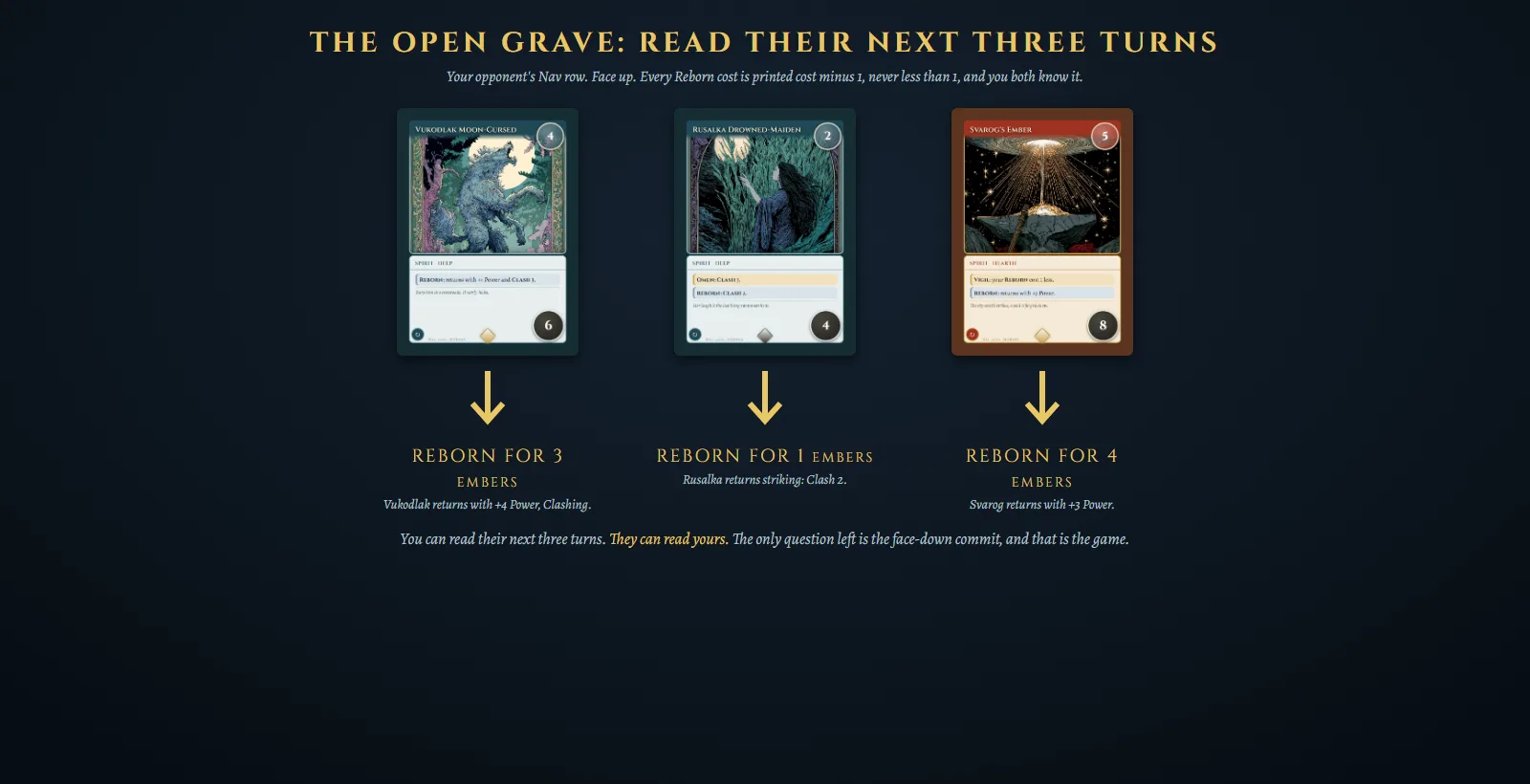
The rule that makes it possible is simple: a Spirit's Reborn cost is its printed cost minus 1, never less than 1, and Reborns are committed like any other play. So a grave is a menu with prices, and both players are holding the same menu. The only thing you cannot see is the single face-down commit each turn, and the whole game lives in that gap.
The signature, diagrammed: their grave is a menu with prices, and you both hold it.
Below are four Nav-Read puzzles: real positions, each checked line by line against the rulebook. The first two are full worked panels with the answer printed beneath the gold fold, so scroll each one slowly. The last two are yours to solve first: tap to reveal the answer when you have committed to a line, the way you would at the table.
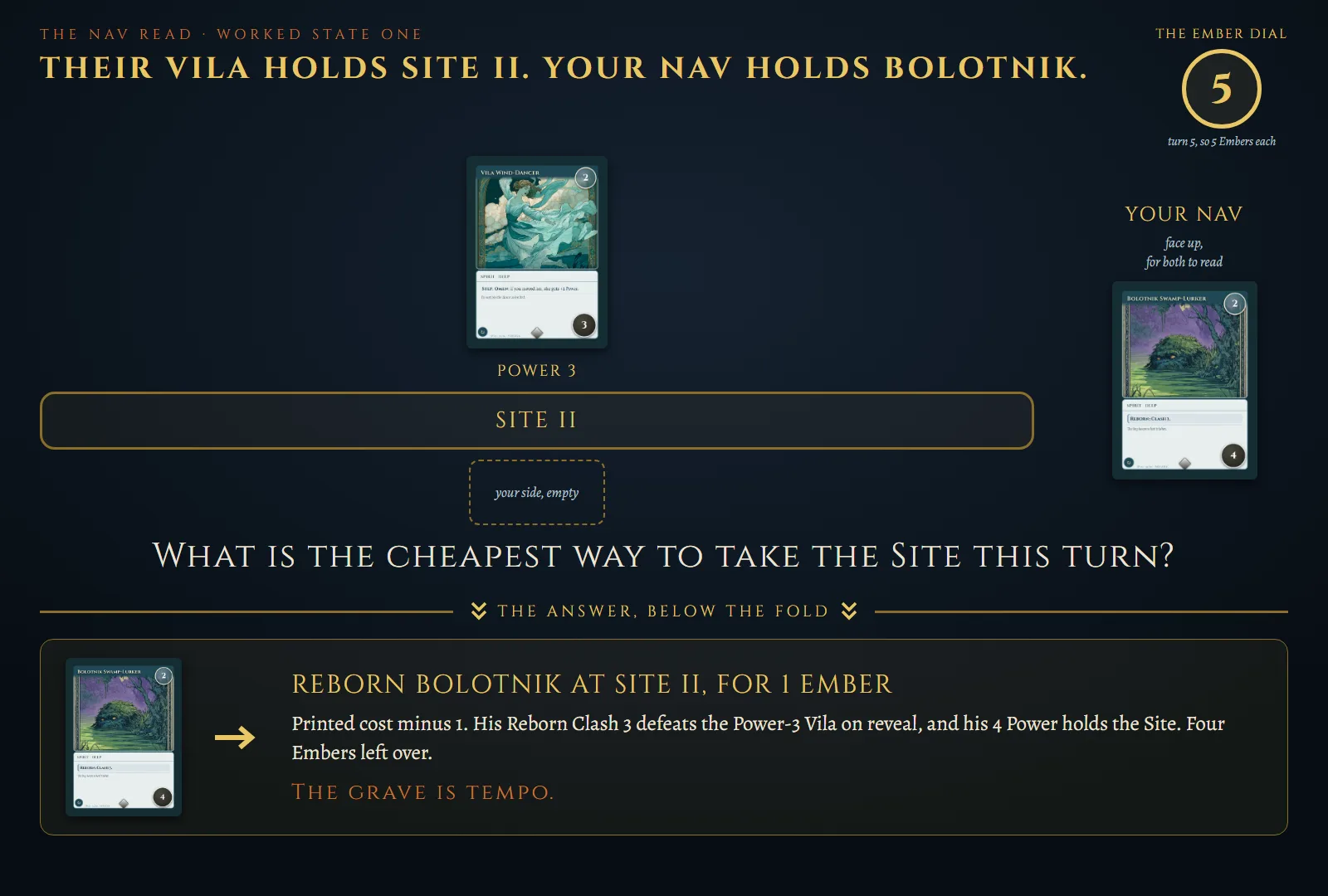
Puzzle I: the cheapest way to take a Site
Worked state one. The answer waits below the gold fold: read the board first.
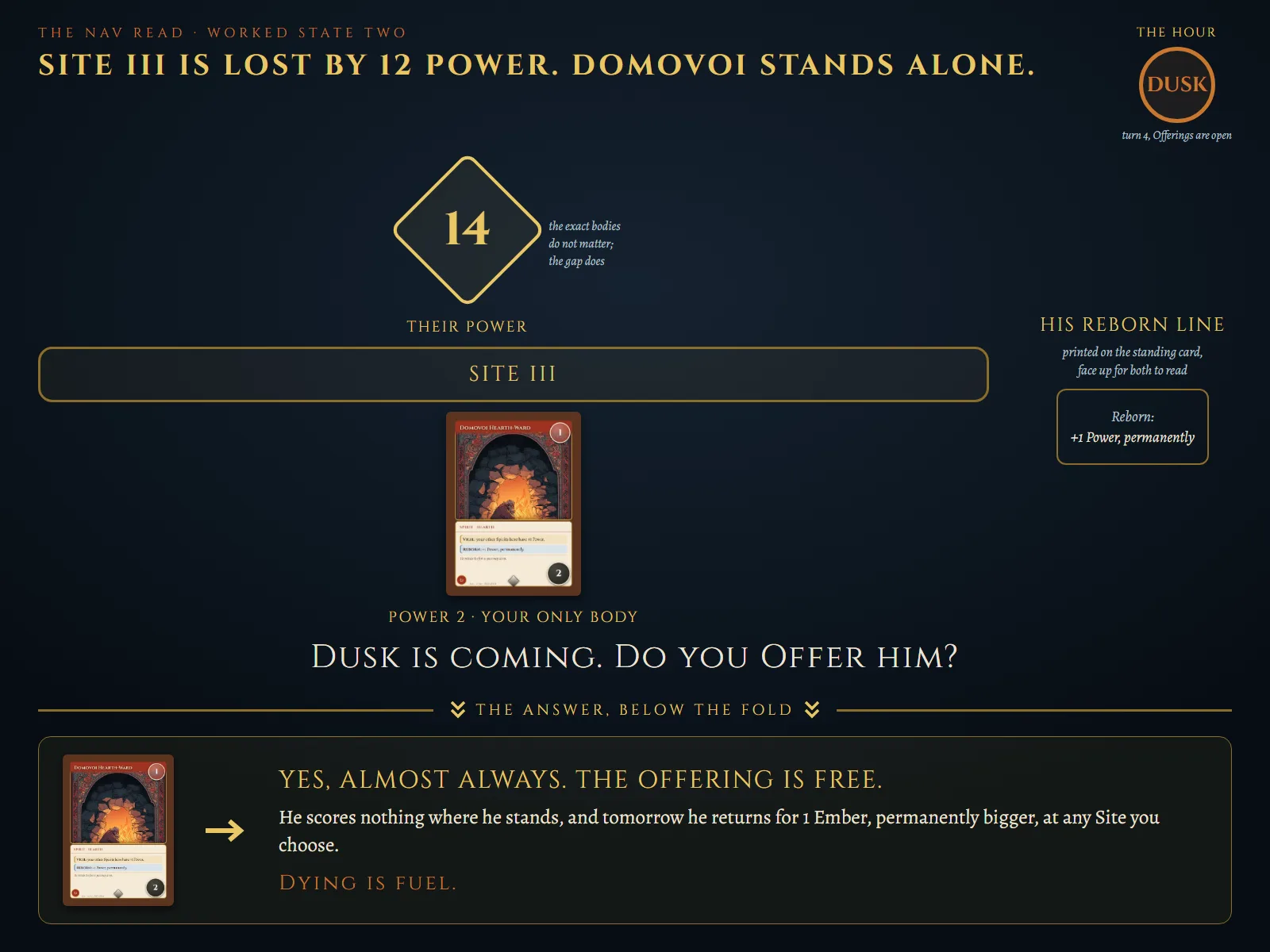
Puzzle II: the Offering call
Worked state two. Dusk is coming, and the Offering is open.
Puzzle III: the bird and the Vigil
Their Alkonost, Bird of Sorrow (3 Embers, Power 4) stands in play. Her card reads: "Vigil: while Alkonost is in play, the enemy gains no Slava from Charms, Omens, or Reborn effects. Site-control Slava is unaffected." Your hand holds The Long Vigil, a 4-Ember Charm: "Gain 1 Slava for each Site you control this turn." You control two Sites.
Do you cast it?
Reveal the answer
No. From her controller's side of the table, you are the enemy: while the bird stands, your Charm Slava is blocked entirely, so the cast would spend 4 Embers to gain nothing. Her hate is a body, not a rule, which is exactly the counterplay: site-control Slava still pays in full, so the real line is the one her own card teaches. Kill the bird or play the board. KILL THE BIRD OR PLAY THE BOARD.
Puzzle IV: seven Embers, four dead, one law
Seven Embers. Your hand holds Night of Nav (4 Embers: "Reborn up to 2 friendly Spirits from Nav to one Site.") and Hearthfire Rekindled (2 Embers: "Reborn a Spirit from your Nav to a Site for free."). Your Nav holds four Spirits.
How many can you return this turn?
Reveal the answer
Two. The law is at most 2 Reborns per player per turn, no matter what the cards offer, and Charms that Reborn count against the limit. You can afford both Charms, 6 of your 7 Embers, which is exactly the trap: affordability was never the constraint. Night of Nav alone reaches the cap for your two best Spirits, and Hearthfire Rekindled is a different turn's play. THE CAPS ARE LAWS.
What the four puzzles add up to
The grave is tempo. Dying is fuel. Kill the bird or play the board. The caps are laws. Four sentences, and you already read the Nav better than most first-night players: in an open-information game, study is just looking, and everything above was checked line by line against the rules reference.
If you want the deeper layer, the strategy guide covers the Ember curve and sequencing the Turning, and the open-information dev log explains why the game hides only one card in the first place. Or skip the reading and feel it: the browser demo is the same rules with the training wheels scripted on.
Questions people ask about the open grave
Is the graveyard really public information in MORANA?
Yes. The Nav, the underworld row where fallen Spirits wait, is open information for both players, always. Every fallen Spirit lies face up with its Reborn line readable by anyone at the table. The only hidden information in the whole game is the single face-down commit each player makes each turn.
What does it cost to Reborn a Spirit?
A Spirit's Reborn cost is its printed cost minus 1, never less than 1. The second life is a bargain, and because both graves are open, both players can count it to the Ember.
How many Spirits can I Reborn in one turn?
At most 2 Reborns per player per turn, no matter what your cards offer, and Charms that Reborn count against the same limit. The caps are laws.
What is a Nav-Read puzzle?
A worked example in a single frozen position: a real board, one question, and the answer beneath the fold. Because MORANA hides only one card per player per turn, a still image can hold everything you need to find the right line, the way a chess puzzle does.
Every position on this page was verified against the MORANA Rulebook and the current card database before publishing; the verification traces live in the project's public design ledger. Card text quoted exactly. The two worked panels and the diagrams are house-made teaching graphics from the game's Glance Kit.